What do
we do?
Brazil’s National Platform for Electric Mobility (PNME, in Portuguese) brings together more than 30 institutions including government bodies, agencies, industry, academia and civil society. New members and partners are continually being added to these “pioneering institutions”, ensuring that the Platform has both the flexibility and the constant flow of knowledge needed to respond to dynamic environmental, social, economic and technological challenges.
PNME members and partners maintain independence of their agendas and interests while at the same time have access to a vast repository of knowledge and articulation to, among other things, provide the industry with:

Promotion and induction to the market
Increased insertion in productive activities

Proposals of public policy and regulatory instruments

Development of research and development skills (R&D)
Why?
What for?
Electric mobility – whether with ultralight, light or heavy vehicles – is already a concrete response to various economic and environmental challenges worldwide. Brazil, with its important automobile industry and its very particular demands for transporting people and cargo, both in urban areas and between cities, is also already embracing electric mobility as another opportunity to promote economic and social development in a sustainable way.
If, on the one hand, there are numerous Brazilian institutions involved in actions in favor of electric mobility in the country; on the other hand, we still do not have a governance structure that articulates these discussions and initiatives to increase their effectiveness. The performance of these structures has been fundamental to the advancement of electric mobility in places such as the United States, China, Europe and Chile.
Networking improves the exchange of information and contributes to the consolidation of learning mechanisms and the formation of competencies. The definition of objectives for the development of electric mobility technology, in addition to consumption and production objectives, helps the agents involved and points out possible paths.
In this context, the National Electric Mobility Platform (PNME), a joint effort of important agents from the Brazilian government, the industry, the academia and the Civil Society, was created as a forum to bring about long-term goals for electric mobility in Brazil, taking environmental, technological, government policy and market points of view into account. Therefore, PNME is not only a space for convergence of objectives and alignment of expectations, but also a vector for the delivery of concrete solutions that meet such expectations.
How do we work?
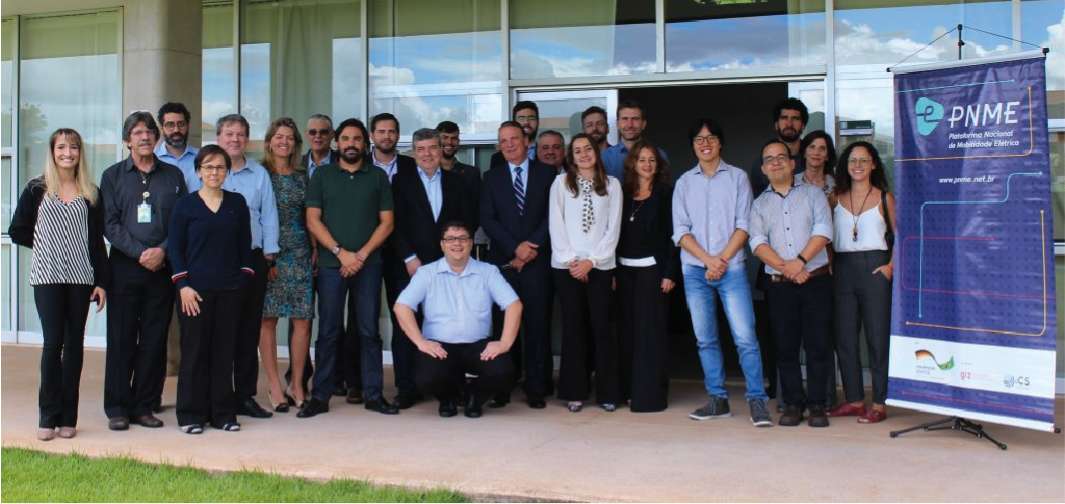
In a flexible and strong structure, designed collaboratively by its members, the Platform currently consists of a Strategic Panel, a Science & Technology Advisory, three Working Groups and a Secretariat, responsible for managing the platform and organizing activities. To ensure neutrality and transparency, the Secretariat is composed of independent institutions: currently, the Institute for Climate and Society (iCS).
The Strategic Panel is the political body responsible for the leadership and strategic planning of the platform, as well as the environment in which the demands of its members are discussed, prioritized and targeted to the proposal of viable solutions.
The Science and Technology Advisory gathers relevant names from electric mobility research in Brazil and provides the Steering Committee with technical advice, guaranteeing the alignment of PNME’s Research and Development efforts.
The Platform also has three Working Groups currently dealing with: Bus Electrification (EBus WG), EBike and Infrastructure and Connectivity; with the possibility of creating others. By engaging relevant agents, WG members focus on more specific issues and aim to deliver products that contribute to the advance of the sector in Brazil.
The Platform also has several national and international partners that are engaged on collaborating with the objectives and mission of the PNME.
